Oklahoma Dog Registration Information
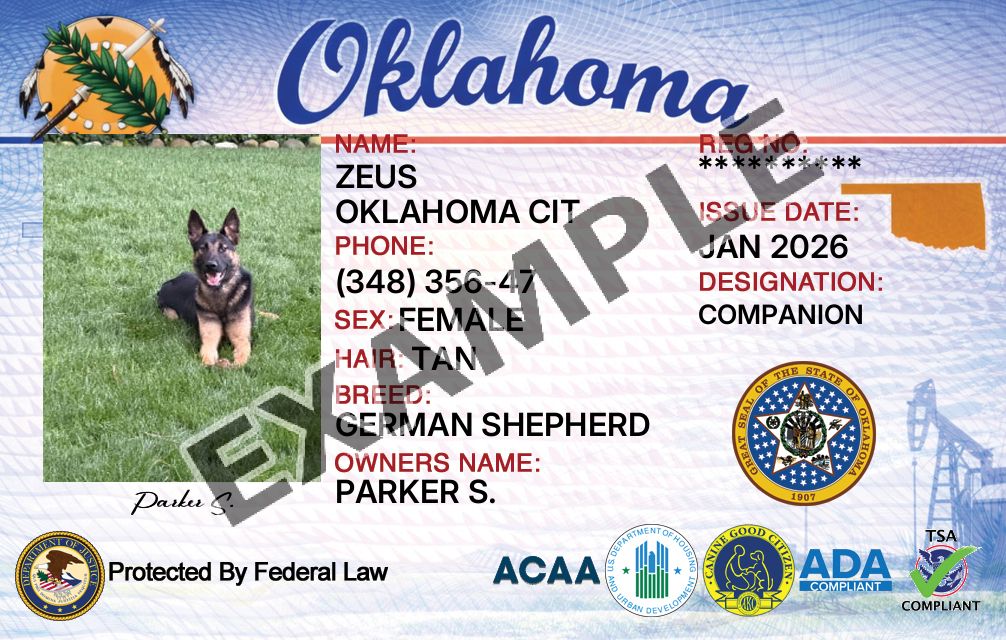
State Licensed, Service Dogs and Emotional Support Dogs in Oklahoma
If you’re asking “where do I register my dog in Oklahoma for my service dog or emotional support dog”, the most important thing to know is this: in Oklahoma, there usually isn’t one single statewide “registration” that turns a dog into a service dog or emotional support animal. Instead, most people are really dealing with two separate topics: (1) local pet licensing/rabies compliance (often handled by your city or county) and (2) disability-related rules that define whether a dog is a service dog or an emotional support animal.
Where to Register or License Your Dog in Oklahoma
Because licensing and rabies enforcement are commonly handled locally, the right place to start is your city animal welfare/animal services office or the agency that provides animal control dog license Oklahoma services for your address. Below are examples of official offices in Oklahoma that residents commonly contact for animal services, rabies compliance, and related local requirements. (Availability of “licensing” varies by city—some communities issue a license tag, some primarily enforce rabies vaccination/tags, and some route licensing through other local offices.)
Oklahoma City Animal Welfare (OKC Animal Shelter)
- Address: 2811 SE 29th St
- City/State/ZIP: Oklahoma City, OK 73129
- Phone: (405) 297-3100
- Email: awinfo@okc.gov
- Office hours (public-facing shelter hours): Tue–Sat, 12:00 p.m.–5:00 p.m. (Closed Sun/Mon/holidays)
Tulsa Animal Services (City of Tulsa)
- Address: 3031 N. Erie
- City/State/ZIP: Tulsa, OK 74115-2805
- Phone: (918) 596-7387 (appointments/intake line listed by the city)
- Office hours (visit/shelter): Open daily, 2:00 p.m.–6:00 p.m. (closed the second Wednesday of each month)
Overview of Dog Licensing in Oklahoma
There isn’t one statewide “Oklahoma dog registration” for pets
Oklahoma does not operate a single, one-size-fits-all statewide pet licensing portal for all residents. In practice, a dog license in Oklahoma is usually created by municipal (city) or county ordinances, and enforcement is typically tied to animal control, shelter intake policies, and rabies vaccination rules. That’s why the most accurate answer to “where do I register a dog in Oklahoma” is often: with the city or county agency that provides animal services where you live.
Rabies vaccination is a core requirement
A common baseline across Oklahoma is the requirement to keep dogs vaccinated against rabies. Under Oklahoma administrative rules, owners/custodians must have a dog vaccinated against rabies by four (4) months of age and then kept current per vaccine labeling directions or stricter local ordinances. Veterinarians who administer rabies vaccines must provide a vaccination certificate meeting minimum standards. This is a key reason many cities focus on proof of rabies vaccination and rabies tags as part of compliance.
Local licensing may be called different things
Depending on the city or county, you might hear:
- “Dog license” (annual or multi-year license)
- “Pet license” (covers dogs and cats)
- “Rabies tag” (issued after vaccination, sometimes treated as the key proof of compliance)
- “Registration” (sometimes used informally even when the legal requirement is “license”)
How Dog Licensing Works Locally in Oklahoma
Step 1: Identify the correct local jurisdiction
Start by confirming whether you live inside a city limit (with its own animal welfare/animal control department) or in an unincorporated county area. Licensing rules commonly attach to where the dog is kept, not where the dog was purchased or adopted.
Step 2: Confirm what your city/county requires (license vs. rabies proof)
Some Oklahoma localities issue a numbered license tag; others focus primarily on enforcing the rabies vaccination requirement and maintaining complaint/impoundment rules. When you call, ask:
- Do you require an annual animal control dog license Oklahoma residents must renew?
- Is the rabies tag considered the “registration,” or is there a separate license?
- Is there a different fee or process if the dog is spayed/neutered?
- Do you require microchip information on file?
- Do you require in-person processing, or can you submit documents electronically?
Step 3: Gather the typical documents
Even when a city does not use the phrase “license,” the same documentation is often requested when a dog is reclaimed, impounded, or involved in an enforcement action:
- Current rabies vaccination certificate from a veterinarian
- Proof of identity
- Proof of residency/address within the jurisdiction
- Payment method for any applicable fee
Step 4: Keep your records current
Keep a digital copy of the rabies certificate and any local license documentation. If you move to a different city within Oklahoma, you may need to update the dog’s information under the new jurisdiction’s rules (even if the rabies vaccine is still current).
Service Dog Laws in Oklahoma
A service dog is defined by training and tasks—not by a registration
A service dog is generally a dog that is individually trained to do work or perform tasks for a person with a disability. The “status” comes from the dog’s training and the handler’s disability-related need—not from buying an ID card, certificate, or online registration.
What you can (and can’t) “register” for a service dog in Oklahoma
You can still be required to follow local rules for a dog license in Oklahoma (or rabies compliance) even if the dog is a service dog. In other words:
- Yes: You may need to obtain the same local dog license/rabies compliance documentation as other dog owners in your city/county.
- No: There is typically no official Oklahoma statewide “service dog registry” you must join for public access.
Public access vs. local licensing are separate issues
Local licensing is about public health and animal control enforcement (especially rabies compliance). Public access for service dogs is about disability law—where the dog can accompany the handler. Mixing these two concepts is the most common reason people search “where to register my service dog” when what they actually need is a local pet license or updated rabies certificate.
Emotional Support Animal Rules in Oklahoma
An ESA is not a service dog
An emotional support animal provides comfort by its presence, but it is not trained to perform specific tasks for a disability in the same way a service dog is. That distinction matters because ESA rules are most commonly tied to housing accommodations, not broad public access.
What “registration” usually means for an ESA
In practical terms, the “paperwork” people think of for an ESA is usually a letter or documentation from a qualified healthcare professional supporting the need for an ESA in housing. This is different from a local dog license. Even with an ESA, you generally still must follow:
- Local dog licensing or rabies compliance requirements
- Leash laws and nuisance ordinances
- Vaccination requirements (especially rabies)
Best practice: keep licensing and housing documents separate
If you need an accommodation for housing, keep your ESA documentation ready for your landlord/housing provider as appropriate. For local compliance, keep your rabies certificate and any city/county license tag current. These serve different purposes and are usually requested by different entities.
Frequently Asked Questions
Register A Dog In Other Oklahoma Counties
Select your county from the dropdown below to get started with your dog’s ID card. Requirements and license designs may vary by county, so choose your location to see the correct options and complete your pup’s registration.
- Adair County Dog Registration
- Alfalfa County Dog Registration
- Atoka County Dog Registration
- Beaver County Dog Registration
- Beckham County Dog Registration
- Blaine County Dog Registration
- Bryan County Dog Registration
- Caddo County Dog Registration
- Canadian County Dog Registration
- Carter County Dog Registration
- Cherokee County Dog Registration
- Choctaw County Dog Registration
- Cimarron County Dog Registration
- Cleveland County Dog Registration
- Coal County Dog Registration
- Comanche County Dog Registration
- Cotton County Dog Registration
- Craig County Dog Registration
- Creek County Dog Registration
- Custer County Dog Registration
- Delaware County Dog Registration
- Dewey County Dog Registration
- Ellis County Dog Registration
- Garfield County Dog Registration
- Garvin County Dog Registration
- Grady County Dog Registration
- Grant County Dog Registration
- Greer County Dog Registration
- Harmon County Dog Registration
- Harper County Dog Registration
- Haskell County Dog Registration
- Hughes County Dog Registration
- Jackson County Dog Registration
- Jefferson County Dog Registration
- Johnston County Dog Registration
- Kay County Dog Registration
- Kingfisher County Dog Registration
- Kiowa County Dog Registration
- Latimer County Dog Registration
- LeFlore County Dog Registration
- Lincoln County Dog Registration
- Logan County Dog Registration
- Love County Dog Registration
- Major County Dog Registration
- Marshall County Dog Registration
- Mayes County Dog Registration
- McClain County Dog Registration
- McCurtain County Dog Registration
- McIntosh County Dog Registration
- Murray County Dog Registration
- Muskogee County Dog Registration
- Noble County Dog Registration
- Nowata County Dog Registration
- Okfuskee County Dog Registration
- Oklahoma County Dog Registration
- Okmulgee County Dog Registration
- Osage County Dog Registration
- Ottawa County Dog Registration
- Pawnee County Dog Registration
- Payne County Dog Registration
- Pittsburg County Dog Registration
- Pontotoc County Dog Registration
- Pottawatomie County Dog Registration
- Pushmataha County Dog Registration
- Roger Mills County Dog Registration
- Rogers County Dog Registration
- Seminole County Dog Registration
- Sequoyah County Dog Registration
- Stephens County Dog Registration
- Texas County Dog Registration
- Tillman County Dog Registration
- Wagoner County Dog Registration
- Washington County Dog Registration
- Washita County Dog Registration
- Woods County Dog Registration
- Woodward County Dog Registration